Tides of Change
An interactive exhibition highlighting the change in relationship somalis had with the Sea from historic symbiotic ties to our current state in the post colonial era.
Curated by Abeer Ali and Samira Abdullahi
- When:
- Where:
- Cost:
- 15th October- 19th December
- Culture House, London
- Free
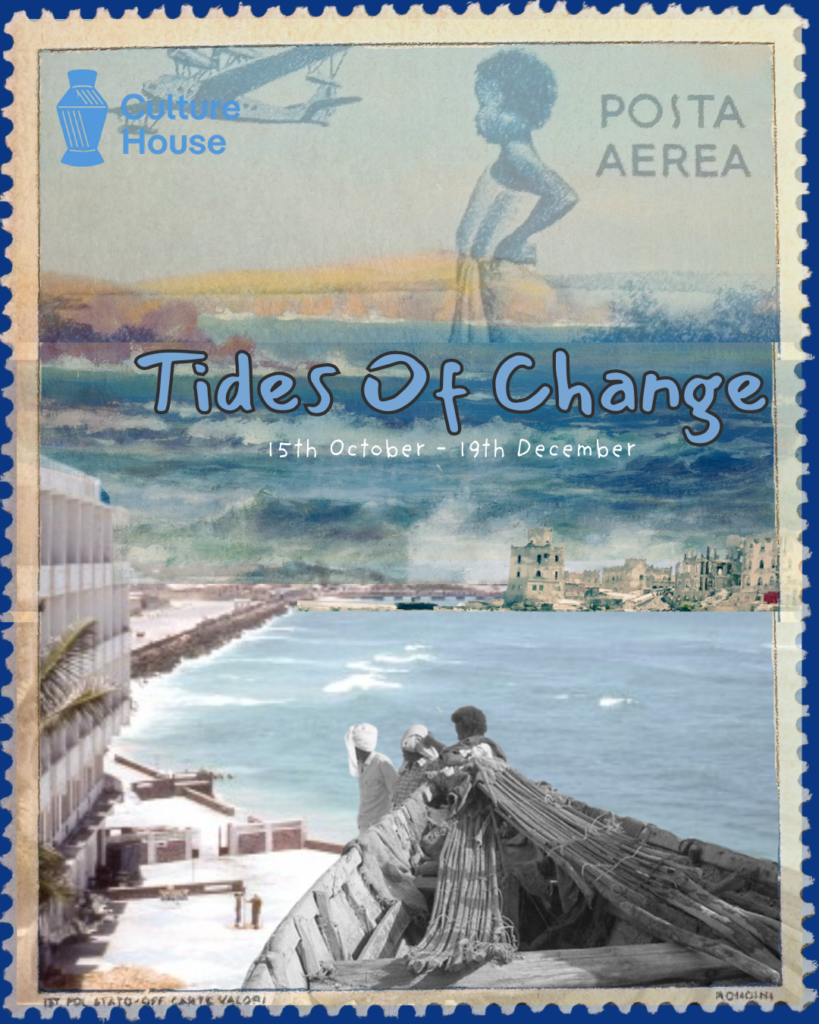
The Story of Somalis changing relationship with the Sea
We’re excited to announce our latest exhibition “Tides of Change”, which will be exploring the changing relationship between Somalis and the sea, before and after colonialism.
The exhibition is split into two main parts Coastal Somali: Living with the Sea and Colonial Seas: Routes Recast by Empire. Both sections are summarised below:
- Coastal Somali: Living with the Sea: Along the Somali coast, the sea was not a boundary. It shaped how people lived. Somali life was shaped by a close symbiotic relationship with the Indian Ocean. Fishing, boat travel, coastal settlement, oral poetry, and everyday craft made the sea part of local memory and knowledge: where boats came in, where goods were carried ashore, and songs remembered work. For coastal communities, land and water were not separate worlds; the shoreline was not an edge but a place of return.
- Colonial Seas: Routes Recast by Empire: Under colonial rule, the sea remained a route of movement, but the terms governing that movement changed. The opening of the Suez Canal in 1869 and the growth of European shipping made the Red Sea and Indian Ocean increasingly important to imperial trade and transport. Somali ports were drawn into these networks not only as places of travel but also as places of supply to serve imperial interests. These changes also drew Somali men into new forms of maritime labour. Many travelled through Aden to Britain, working aboard merchant ships and in the docks, while others later found employment in industrial towns. Through these journeys, Somalis established some of the earliest Somali communities in Britain, particularly in London, Cardiff and Liverpool. Somali relationships with the sea continued, but under changing conditions of movement and control.
Elements of the exhibition – Images and Physical Objects
- Archival sketches from the 1800s of Somali coastal cities
- Objects from the coast: a bag adorned with cowrie shells, a conch shell and necklaces traded across the Gulf of Aden
- Archival photographs from 1914-1980s featuring Somali sailors in WW1, trade of resources (bananas, camels), ruins of an ancient market were trade occurred with the Greco-Romans and Ancient Egyptians, fishing and boatmaking practices
- Postcards and stamps featuring the various colonial powers governing Somali regions
- Archival maps showcasing the division of land and the expansion of colonial control over the region
- Racialised painting of a Somali woman picking cotton
- Objects from the coast: a bag adorned with cowrie shells, a conch shell and necklaces traded across the Gulf of Aden
- A 9-minute short film featuring the oral histories of Somalis who were sailors and/or migrated to the UK
Free